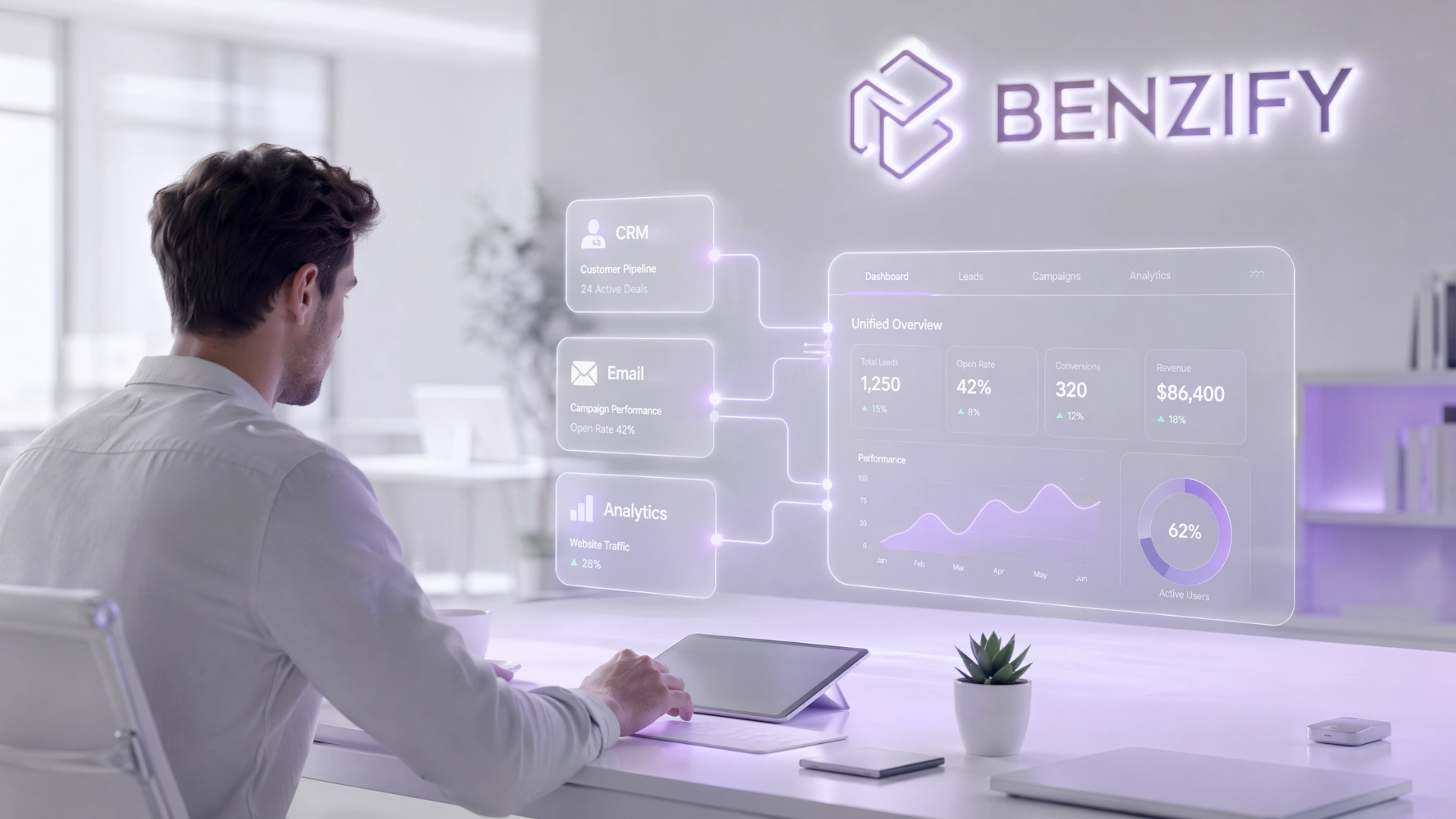
Is your business growth starting to feel less like a powerful, roaring engine and more like a sputtering lawnmower engine that you have to constantly coax and cajole? You’re not alone. In 2026, many ambitious business owners are encountering the same silent killer of scale: a collection of disconnected software, tools, and processes. They have dozens of apps a sleek CRM, a robust email marketing platform, separate software for e-commerce, and various operational tools but no single, unified system that works in concert. They are drowning in tools but starving for efficiency.
At Benzify, we’ve learned that the secret to scalable success isn’t finding the newest “miracle tool” on the market. It’s about building a coherent growth system that integrates these elements, ensuring every piece of data and every action fuels the overall mission. When you move beyond disconnected tools, you unlock the real growth power. Here’s a deep dive into why this shift is crucial and how you can achieve it.
The Hidden Cost of Disconnected Tools in Your Growth Stack
The proliferation of tools has been a boon for innovation, but it has a massive downside. Every new point solution adds a new silo. It becomes a separate database with its own user interface, reporting, and rules. When your sales team lives in one tool, your marketing team in another, and operations in a third, the business starts to fracture.
This disconnect creates several critical bottlenecks that strangle your ability to grow effectively:
- Data Silos and Poor Decision-Making: When data is scattered, getting a single, accurate view of your entire business (and especially of your current and potential customers) is nearly impossible. This leads to decision making based on incomplete or even conflicting information.
- Inefficient Workflows and Massive Time Drains: Imagine manually exporting data from your ecommerce platform and importing it into your email tool, then copying notes from your CRM to a team collaboration tool. The amount of “swivel chair automation” manually moving data is a huge drain on time and resources that should be spent on strategic tasks.
- A “Stop and Go” Customer Experience: From your customer’s perspective, these gaps are visible. They receive disjointed messages, find themselves repeating their information, and often feel like they are interacting with three different companies instead of one. This kills retention and brand loyalty.
Building Your Strategic Growth System for 2026 and Beyond
So, what’s the alternative? It’s not about scrapping every tool you own. It’s about taking a step back and moving from a tools first mindset to a system first mindset. A successful growth system focuses on architecture, not just apps. It’s about building a foundation that connects your different functions to create a frictionless environment for growth.
Here’s a proven strategic approach:
Step 1: Define Your Business Architecture First
Before you evaluate another single piece of software, you need to draw a map. Define exactly how money, customers, and data flow through your business. What are the key stages of your customer lifecycle? What are the core processes of your internal teams? This architectural blueprint should be agnostic of any specific software. By mapping these flows, you will identify exactly where the friction points and data gaps are. This is your foundation.
Step 2: Establish a Core Data Hub with AI Management
One of the most effective strategies we use at Benzify is the establishment of a “single source of truth.” In 2026, we lean heavily into using artificial intelligence (AI) to manage and normalize this data hub. Instead of just pushing raw data between apps, an AI driven data layer (often acting as a customer data platform or CDP) collects, cleans, deduplicates, and resolves customer identities from multiple sources.
This gives you a complete, real time 360 degree view of every client. AI can then push enriched and synchronized data back to your operating tools, ensuring everyone works with the exact same, high quality information. It’s a powerful multiplier.
Step 3: Integrate and Automate the Client Lifecycle
With a central data hub, true automation becomes possible. You can create triggers that cross application boundaries. For instance, an operational action in your fulfillment software can trigger a tailored retention email from your marketing tool.
Looking at your business through a lifecycle lens, let’s see how a growth system would solve problems for different business models we frequently assist:
Solving for a B2B SaaS Leader (Automation Focus)
For a SaaS leader (similar to one of our case studies), a disconnected stack might lead to a slow onboarding process. A central system can automate the moment a lead converts. The system immediately creates their account in the SaaS application, triggers a welcome email sequence from the CRM, generates a task in a project management tool for the customer success team, and sends a notification to a Slack channel for the sales team. The customer experiences immediate value, and the internal teams are instantly aligned.
Solving for an Ecommerce Brand (Retention Focus)
For an ecommerce brand, a system can connect past purchase data with email and advertising platforms. This allows for hyper personalized, trigger based marketing. If a customer has made three purchases of a specific product type, the system can automatically place them into a “VIP” segment and send them a unique cross sell offer that an AI model has calculated as their next most likely purchase. Retention rates soar because the communication is always relevant.
Solving for a Coaching Agency (Operational Focus)
A coaching agency can use a system to connect booking, payment, and client delivery. When a client books an appointment, the system automatically process the payment, sets up their client portal, pushes an agreement to them for signing, and sends pre session materials all without a single manual step from the business owner. This frees up massive amounts of time to focus on delivering amazing value to clients.
Measuring and Iterating for Continual Growth
Building a system isn’t a one-time project. It’s a fundamental part of your ongoing growth operations. The beauty of a systemized approach is that it generates incredibly rich data. You can now measure the efficiency of your entire process, not just individual campaigns. You can see how long it takes for a lead to move from “Qualified” to “Closed” and identify the exact step that causes a bottleneck. This visibility lets you make precision improvements and continuous iterations that fuel sustained growth.
In 2026, the biggest competitive advantage is not a larger marketing budget; it’s a more efficient, smarter growth system that works as a cohesive unit.
Key Takeaways for Business Growth
- System over Tools: Focus on building a coherent system that integrates your tools, rather than just adding more tools to the stack.
- Define Your Architecture: Map out your customer and data flows before selecting technology.
- Centralize Data: Create a single source of truth for all business and customer data, ideally with AI powered normalization.
- Lifecycle Focus: Integrate your client lifecycle stages (sales, marketing, content, retention) to create a frictionless experience for your clients.
- Focus on True Value: True value from data and technology comes from a system, not disconnected point solutions.
Conclusion: It’s Time to Build Your Growth Engine
The era of disconnected tools is over. If you want your business to reach its full potential in 2026, you can no longer afford to let your apps work in isolation. The hidden costs of manual data entry, data silos, and a poor customer experience are simply too high.
At Benzify, we don’t just sell tools. We build the systems that grow your business. We can help you stop spinning your wheels with disconnected point solutions and start building a unified, automated, AI powered growth system that connects your sales, marketing, and entire client lifecycle.
Are you ready to stop running multiple businesses and start running one highly efficient growth engine? Click here to start building your system today.
Frequently Asked Questions (FAQ) About Business Growth Systems
1. What is a “growth system”?
A growth system is a collection of integrated software, platforms, and processes designed to work together as a single, coherent unit to drive business growth. It goes beyond using different tools for different functions (like a CRM for sales and a separate email tool for marketing) by creating deep connections between them to ensure data flows seamlessly, automations are end-to-end, and the entire business has a single source of truth.
2. How is a growth system different from a CRM or a tech stack?
Think of your tech stack as a collection of instruments in an orchestra. A CRM is one very important instrument, like the first violin. A “growth system” is the musical score and the conductor that tells all the instruments when to play and how to play together to create a harmonious symphony. It’s the strategic layer that integrates and harmonizes all your individual tools.
3. My tools are already connected. What am I missing?
Most current integrations are basic “Zapier” style triggers if this happens in app A, then do that in app B. A true growth system focuses on deep, two-way data synchronization and operational workflows. This often requires a central data hub or a semantic data layer to normalize and enrich information so that every tool in your stack is working from the same high quality intelligence.
4. What are the signs that my growth system isn’t working?
Common indicators are that your teams are wasting hours on manual data transfer, you have conflicting data in different systems, you struggle to create end to end automations, and your customers experience a fragmented, inconsistent journey. If you feel like your tech is a constant source of friction rather than a strategic advantage, your system likely needs an overhaul.
5. Do I need to replace all my current software to build a system?
Absolutely not. In fact, most of the time, the solution is not to get more tools, but to make your existing tools work together in a meaningful way. We can often help you squeeze significantly more value out of the platforms you already pay for by building a central data hub and unifying the architecture.
6. How can AI help in building a business growth system in 2026?
AI is a critical component for system building. In 2026, AI is used to manage the “data layer.” An AI model can collect raw, messy data from your various platforms, clean it, deduplicate it, merge customer identities, and provide a single, rich, normalized view of every customer. This creates a powerful foundation that makes every subsequent automation and insight much more intelligent.