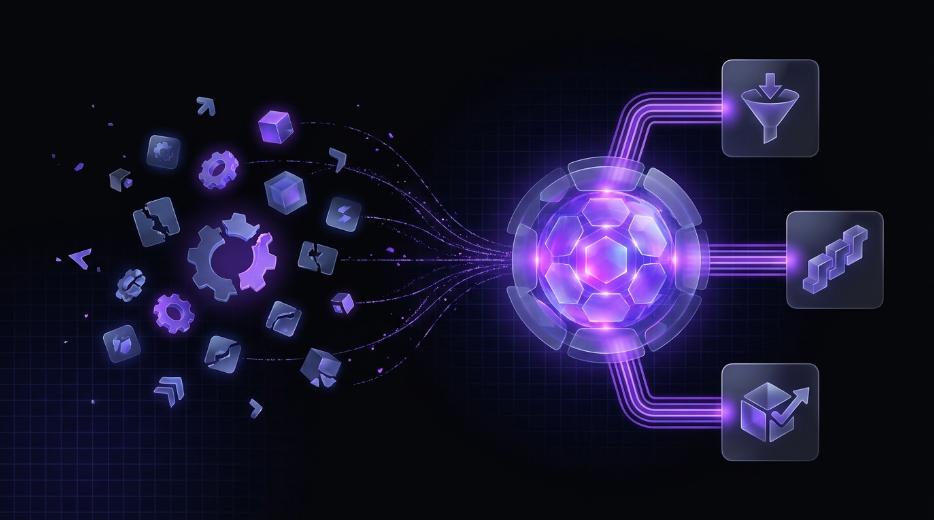
Is your team spending more time moving data between software applications than actually closing deals and serving customers?
Modern enterprises frequently fall into the subscription trap. When a new operational challenge emerges, leadership purchases another standalone SaaS subscription. Marketing adopts one platform, sales utilizes another CRM, customer service relies on separate ticketing software, and fulfillment operates inside disconnected spreadsheets.
On paper, every department appears modern and agile. In practice, data silos multiply, subscription costs escalate, and manual workarounds drain valuable productivity. True scalability does not come from accumulating dozens of isolated tools. Sustainable expansion requires an integrated, high performance growth infrastructure.
Here is how modern organizations eliminate operational friction, connect their workflows, and leverage unified systems to achieve scalable profitability.
The Hidden Cost of Software Fragmentation
Software bloat creates unseen bottlenecks that erode profitability. When applications fail to communicate smoothly, human employees end up functioning as the integration layer.
1. The Cost of Manual Synchronization
When contact records, inventory counts, or client updates require manual re entry across multiple dashboards, human error becomes inevitable. Duplicate records emerge, customer interactions get missed, and team morale suffers from tedious busywork.
2. Slower Lead Response Velocities
Speed is paramount in lead acquisition. When incoming inquiries sit unrouted inside a third party form instead of triggering instant follow ups, conversion rates drop dramatically. A connected system ensures zero friction from discovery to conversion.
3. Incomplete Customer Journey Analytics
Disconnected databases prevent leadership from seeing accurate acquisition costs, customer lifetime value, and churn rates. Without clear visibility, marketing budgets get misallocated into channels that fail to generate actual ROI.
Building an Integrated Business Architecture
Scaling past operational plateaus requires transitioning from isolated point solutions to a holistic operating framework. A robust ecosystem brings marketing, sales pipeline management, and internal fulfillment under one reliable architecture.
When you engineer bespoke automation workflows across your company, you eliminate operational lag while creating predictable revenue pipelines.
+ ——————————————————- +
CENTRAL BUSINESS DATA CORE
+ ——————————————————- +
[ Lead Capture ] [ CRM Pipeline ] [ Auto Fulfillment ]
Instant web forms, Automated stages, Invoicing, tasks,
social ad synching, task alerts & AI onboarding flows &
omnichannel alerts deal nurturing client delivery
Unifying Inbound Lead Capture
Every inbound lead from search engines, paid campaigns, or direct referrals should instantly enter your central engine. Automated validation cleans the contact information, scores the prospect based on intent signals, and assigns the deal to the appropriate account executive within seconds.
Automated Client Onboarding
First impressions define client retention. Instead of sending manual emails requesting details, an automated onboarding sequence delivers welcoming materials, creates project files, triggers secure payment collection, and schedules initial kickoff sessions automatically.
Centralized Operational Intelligence
A single dashboard provides executives with clear, real time operational reporting. Knowing exact revenue figures, pipeline velocities, and support resolution times allows leadership to make strategic decisions backed by verifiable data.
Core Pillars of a Scalable Digital Infrastructure
To maximize efficiency and return on investment, an enterprise system must stand on three essential pillars:
Working alongside a dedicated system architect like Benzify allows organizations to replace fragmented subscriptions with custom engineered digital assets that drive tangible commercial success.
Practical Blueprint to Consolidate Your Business Systems
Transitioning to a unified framework does not require stopping your ongoing operations. Follow this step by step roadmap to modernize your infrastructure systematically.
Audit Your Active Subscriptions
Catalog every piece of software your organization pays for monthly. Identify overlapping features, underutilized accounts, and manual steps required to transfer information between these tools.
Map the Critical Path of Your Customer Journey
Trace every interaction a prospect experiences, starting from initial brand discovery through payment, delivery, and ongoing support. Highlight bottlenecks where prospects experience delays.
Establish a Central Source of Truth
Select or build a central engine to house your primary customer records and analytics. Ensure all peripheral applications feed data directly into this core database.
Deploy Milestone Automations
Begin by automating high value touchpoints:
- Instant SMS and email responses for new inbound prospects
- Automated proposal delivery and document signing sequences
- Automated billing reminders and recurring subscription charges
- Task assignment alerts for account managers upon contract signing
Review Performance Metrics Regularly
Analyze lead conversion rates, support ticket turnaround, and team output every month. Continuously refine your system logic to maximize team capacity and customer satisfaction.
Frequently Asked Questions
What does a unified business automation system do?
A unified business automation system connects your marketing channels, customer relationship management, invoicing, and service delivery into a synchronized infrastructure. It removes manual data entry, speeds up lead handling, and provides centralized operational visibility.
How does eliminating disconnected tools reduce company expenses?
Consolidating fragmented tools lowers software licensing fees, eliminates duplicate platform features, and significantly cuts the labor hours your team spends manually copying information between different databases.
Can custom automation integrate with existing enterprise tools?
Yes. Professional integration connects your essential industry specific applications via robust application programming interfaces, ensuring unified data flow while retaining critical legacy functions.
How quickly can a business see ROI from system consolidation?
Most companies observe positive returns within thirty to ninety days. Speed improvements in lead response times, reduced administrative overhead, and higher sales conversions immediately impact profitability.
Is unified automation suitable for small to mid sized businesses?
Yes. Mid market and growing businesses gain significant advantages because automation enables smaller teams to handle enterprise volume without requiring massive hiring budgets